
Axl Imperial is an international manufacturer and supplier of automation, measurement control and testing devices for advanced industrial and laboratory use.
Utilising the design of state-of-the-art equipment and know-how in the field of automation and high-precision industrial measurement and control, Axl Imperial offers production processes and automation solutions to the most demanding needs of modern industry.
Consisting of a variety of engineers, each with great experience in specific industrial segments as automation, motion, measurement and control, the company provides integrated services, from design, development and installation of industrial equipment, to technical consulting, service and after-sales support, for all industrial needs as high precision in-line and laboratory measurements and quality control.
Axl Imperial seeks to constantly improve the quality of the services and systems provided, with the sole criterion, the principle, that quality and economy in production are the key prerequisites for a healthy industrial development and high quality products.
Machine Tending
Automation
Machine Tending Automation: The Robotic Application That Frees Your Most Skilled Workers for Better Work
Walk into any machining or manufacturing facility and you will possibly find at least one qualified worker on the production floor doing a not so qualified job.
For example, a CNC operator with years of experience in setup, programming, and process troubleshooting, standing at a machine, opening the door, removing a finished part, loading a new blank, closing the door, and pressing cycle start. Then waiting until the machine has finished its task. Then doing it again.
While the machine is running, the operator is present and quite possibly remains idle. Thus, a significant proportion of both his/her time and capability is being consumed by a task that requires neither experience, nor judgment, or any particular skill. This is machine tending, and it is one of the most consistently overlooked automation opportunities in manufacturing.
Whis Is Machine Tending Usually Overlooked
Machine tending sits in the middle of the production process, between upstream material supply and downstream quality inspection or assembly. It does not generate the same visibility as palletizing or case packing, because it is distributed across individual machines rather than concentrated at a single station. But the cumulative labor hours absorbed by manual machine tending across a facility with ten, twenty, or fifty CNC machines, injection molding presses, or stamping units is substantial, and the profile of that labor is what makes the automation case particularly compelling.
Unlike palletizing or parts handling, where the task is physically demanding but relatively unskilled, machine tending is frequently performed by operators who are capable of considerably more. Setting up a machine, adjusting parameters, diagnosing a quality issue, managing a changeover: these are the tasks that trained production operators are qualified to perform and that genuinely benefit from human expertise. Loading and unloading the same machine at the same interval across an eight-hour shift is not one of them.
Machine Tending Robotic Cell: What It Involves and What It Offers
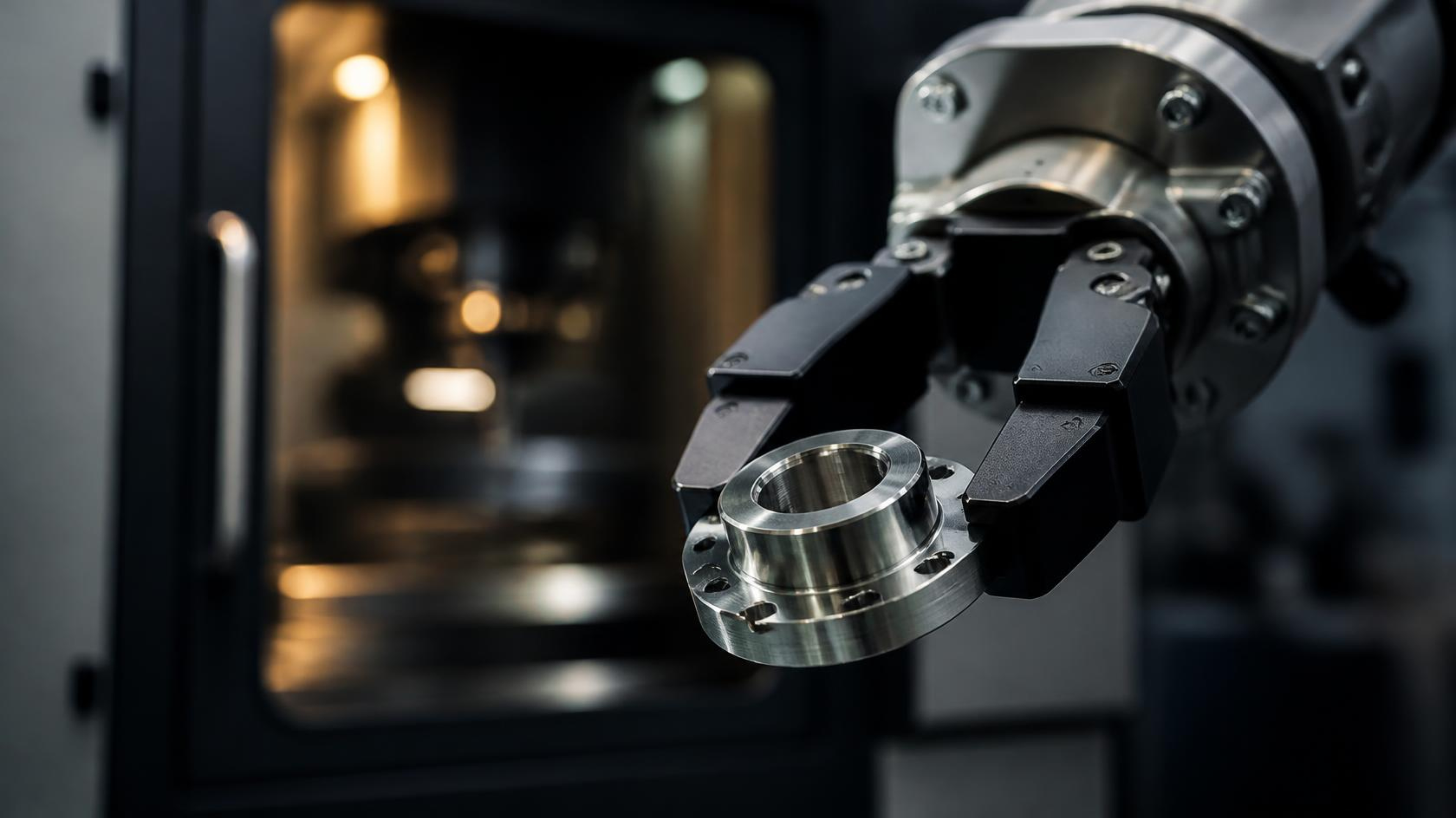
A robotic machine tending cell is, at its core, a robot positioned to interact with the machine in place of the human operator. The robot opens and closes the machine door, removes finished parts, loads new blanks, and initiates the next cycle. The components that make this work reliably in a production environment extend beyond the robot arm itself.
One of the prerequisites for this automation upgrade to deliver a good result is the gripper tooling to match the specific part geometry. The robot must handle the part without damaging it or dropping it, across the full range of positions and orientations it will encounter. A part presentation system, whether a conveyor, a vibratory feeder, or a structured storage rack, ensures parts are available to the robot in a known and repeatable position. If this is not possible, then an industrial camera is deployed to inform the robot of the exact position of each part. Integration with the machine's own control system, typically via a digital input/output signal or a communication protocol, allows the robot and the machine to coordinate their cycles without manual intervention. Safety systems, including area scanners, light curtains, or physical guarding depending on the robot type and operating speed, define and protect the zone within which the robot operates.
Increasing Productivity With Machines That Do Not Wait
The most immediate and quantifiable benefit of machine tending automation is the reduction in machine idle time between cycles. A human operator tends a machine at a pace set by attention, fatigue, and the various interruptions that occur in any working shift. A robot tends the same machine at a pace set by the programmed cycle, consistently, across every shift, without variation.
On a machine with a 90-second cycle time, the difference between a human-tended loading interval of 15 seconds and a robotic one of 8 seconds may appear marginal per cycle. Across hundreds of cycles per shift and multiple shifts per day, that difference accumulates into a meaningful increase in overall equipment effectiveness. More significantly, robotic machine tending enables unattended or lightly attended operation across second and third shifts, night shifts, and weekends, transforming a machine that previously ran one attended shift per day into one that runs productively for two or three. For capital-intensive equipment, this improvement in asset utilization alone frequently justifies the automation investment.
Flexibility for Diversified Environments
One of the most common objections to machine tending automation has been the assumption that it only makes economic sense on dedicated, high-volume production lines. Modern machine tending cells, however, have moved well past that limitation.
Current cobot-based machine tending systems can be reprogrammed for different part types, loading orientations, and machine interfaces without major mechanical reconfiguration. In environments where handling a high mix of part types across the same machines is important, a single robot can be programmed for each part family and switched between them as the production schedule changes. Quick-change gripper systems allow the tooling to be swapped in minutes rather than hours. This flexibility puts reprogramming within reach of trained operators rather than specialist integrators, and it makes machine tending automation viable for a far broader range of facilities than was the case a decade ago.
From Fixed Cells to Mobile Platforms
For facilities where machine tending requirements are distributed across many machines in different areas of the production floor, the fixed robotic cell model has a natural constraint: each machine requires its own dedicated installation. Purpose-specific industrial humanoids are beginning to offer a different approach to this challenge. Axl Imperial's MARK One platform, for example, is designed for exactly this kind of mobile, multi-machine tending scenario: a single platform that moves autonomously between workstations and performs the loading and unloading tasks that would otherwise require either multiple fixed cells or continuous manual attendance. For operations with a broad and variable machine tending footprint, this represents a meaningfully different automation model and a different kind of ROI calculation.
Skilled Workers Belong on Skilled Tasks
Machine tending automation does not eliminate the need for skilled production operators. It eliminates the need for skilled production operators to spend their time on a task that does not require their skills. The operator freed from loading a CNC machine every 90 seconds is available to set up the next job, monitor quality across multiple machines, troubleshoot a process deviation, or support a changeover. That reallocation of human capability is, for many facilities, as valuable as the direct productivity gain from the robot itself.
The workforce shortage affecting manufacturing operations across Greece, Europe and the rest of the world, is not going to resolve itself. But the applications where that shortage is felt most acutely are also the applications where robotic automation has the clearest, most immediate, and most measurable answer. Machine tending is one of them.
Axl Imperial designs and installs machine tending robotic cells across a range of manufacturing environments. Contact us to discuss which configuration fits your machines and your production profile.
Contact Us More Articles