
Axl Imperial is an international manufacturer and supplier of automation, measurement control and testing devices for advanced industrial and laboratory use.
Utilising the design of state-of-the-art equipment and know-how in the field of automation and high-precision industrial measurement and control, Axl Imperial offers production processes and automation solutions to the most demanding needs of modern industry.
Consisting of a variety of engineers, each with great experience in specific industrial segments as automation, motion, measurement and control, the company provides integrated services, from design, development and installation of industrial equipment, to technical consulting, service and after-sales support, for all industrial needs as high precision in-line and laboratory measurements and quality control.
Axl Imperial seeks to constantly improve the quality of the services and systems provided, with the sole criterion, the principle, that quality and economy in production are the key prerequisites for a healthy industrial development and high quality products.
Palletizing
Without
the Fatigue
Palletizing Without the Fatigue: Why Collaborative and Industrial Robots Are Replacing the Most Punishing Job in a Factory
If you ask any production manager today, "which station on the factory floor has the highest staff turnover, the most frequent injury reports, and the most inconsistent output quality across a shift", the answer is usually the same: the palletizing station.
The numbers behind manual palletizing tell a convincing story that most operations managers know from experience but rarely quantify. A palletizing worker who continuously lifts products across an eight-hour shift, ends his day having handled several tons of material by the end of the day. The lifts are repetitive, the postures are awkward, and the pace is set by the production line rather than by what the human body can comfortably sustain. This is why musculoskeletal injuries from manual palletizing are among the most common in manufacturing, which leads to high staff turnover at these stations. And as fatigue accumulates through the shift, accuracy and stacking consistency degrades, which means pallet stability, load integrity, and downstream logistics quality all suffer along with it.
The issue for most production facilities is no longer whether to automate palletizing. The increasing shortage of industrial workers makes this a one-way solution. So, the question shifts in which robotic solution fits their specific application best, and what a complete palletizing system should involve.
Why Palletizing Is Usually the First Application Factories Automate
When manufacturers take their first steps into robotics, palletizing is most frequently the entry point. And it makes complete sense, as it is one of the most clearly defined, repetitive, and physically standardized tasks on the production floor.
The input is consistent: boxes, bags, trays, or cases arriving from the production line at a known rate. The output is well defined: a stacked pallet built to a specified pattern and height. Furthermore, the task does not need complex judgment to be fulfilled. On the contrary, it requires strength, endurance, and consistency, qualities that a robot delivers more reliably than a human over an extended working period.
The financial argument for palletizing automation is also quite straightforward. Recruitment and training costs for palletizing operators are recurring. Sick leave and workers' compensation claims related to manual handling injuries add up. Now, view this next to declining availability of workers willing to perform heavy repetitive lifting. It becomes evident that automating palletizing does not just improve operational efficiency. It removes a staffing dependency that is becoming harder to manage.
Collaborative Robots in Palletizing: Flexibility and Accessible Entry
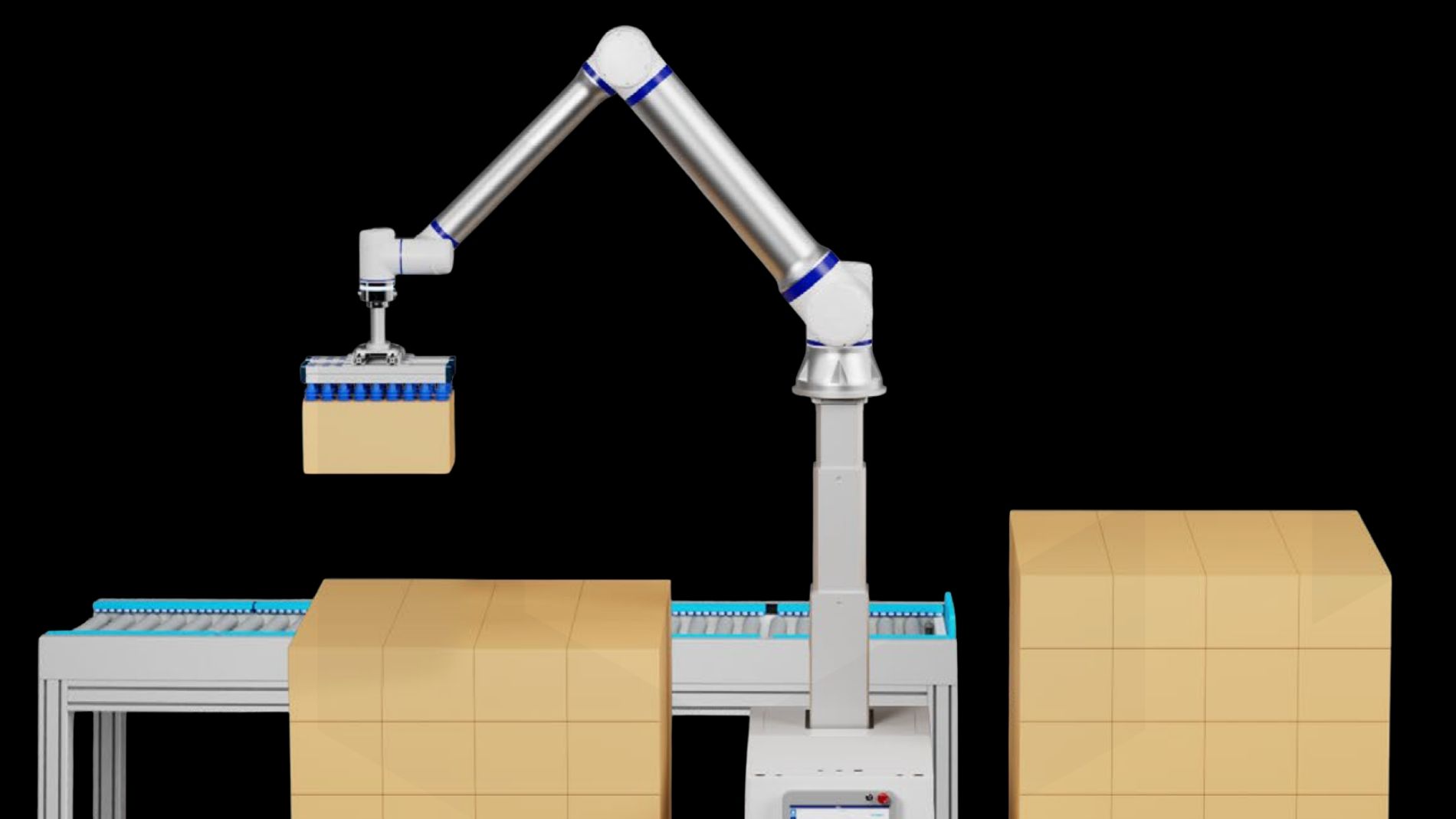
Collaborative robots, or cobots, have brought robotic palletizing within reach of a much broader range of manufacturing operations over the past decade. Designed to work next to human operators without requiring full safety guarding, cobots offer a combination of flexibility, ease of programming, and relatively accessible investment levels. Altogether, these attributes make them a practical starting point for production plants new to automation.
In palletizing applications, cobots perform well across a defined range of payload and throughput requirements. They can be reprogrammed quickly to accommodate different pallet patterns, product types, or box sizes, which makes them particularly well suited to operations handling multiple SKUs or running frequent product changeovers. Set up and integration are generally of low complexity, and the ability to operate alongside human workers without a full safety enclosure simplifies floor layout and reduces the infrastructure investment required.
However, there are limitations for using cobots in palletizing, which we need to clearly address. Payload capacity has a ceiling that the latest cobot models are steadily pushing upward, but which still constrains their suitability for heavier products. In real industrial applications, a cobot can handle a maximum stacking rhythm of 6-8 products per minute. Operating speeds are lower than those of industrial robots, which means that on very high-throughput lines, a cobot-based palletizer may not be able to keep pace with production output. For operations within those parameters, however, cobots represent a well-proven and commercially attractive palletizing solution.
Industrial Robots in Palletizing: Speed, Payload and Continuous Throughput
When the application demands exceed what a cobot can deliver, industrial robots take over. High-payload products, demanding cycle times, 24-hour production schedules, and lines running at speeds surpassing the constraints of collaborative systems, all point toward industrial robot-based palletizing as the appropriate solution.
These robotic systems can handle heavy and non-standard shaped loads consistently, run continuously without performance degradation, and maintain cycle times that match the output of high-speed production lines across multiple shifts. For food and beverage, building materials, chemical, and heavy consumer goods manufacturers operating at scale, industrial robots have been the backbone of automated palletizing for decades, and their reliability and throughput credentials are well established.
The trade-offs are also quite clear. Industrial robot installations require safety fencing or area-scanning systems to protect workers from the operating envelope. Programming and integration are more complex, which makes the upfront investment higher. Moreover, frequent product changeovers require more deliberate engineering and increase the non-productive time. And although these are not reasons to avoid industrial robots palletizing, they are factors to weigh in against the application requirements before reaching a decision.
The Complete Palletizing Cell: More Than Just the Robot Arm
One of the most common misconceptions about robotic palletizing is that the robot itself is the complete system. In fact, the arm is one component within a broader set of integrated equipment that determines whether a palletizing cell functions reliably and efficiently in a real production environment.
A complete robotic palletizing cell typically includes an infeed conveyor system that receives product from the production line and delivers it to the robot appropriately calibrated: at the correct position and orientation. In some applications, where products come randomly and unpredictably, a vision system may be used to identify the exact position and orientation of each incoming product, allowing the robot to pick accurately. When there are flow differences between the production line speed and the palletizing cycle, buffering stations can help the robot manage the extra load. In addition, pallet dispensers may be used to supply empty pallets automatically, so that our system is not dependent on manual pallet handling. Furthermore, HMI control panels can give operators visibility and control over the entire cell from a single interface. And safety systems, including fencing, light curtains, and area scanners, help us define and protect the robot operating zone.
Depending on the production site and the complexity of the palletizing application itself, the value of a pre-integrated palletizing cell, where all above components have been engineered and configured to work together, may prove significant. It reduces the installation timeline, simplifies commissioning, and attributes the responsibility for system performance to a single supplier, rather than being distributed across multiple vendors. For manufacturers today, this distinction between a standalone robot and a complete automated palletizing cell is one of the most important practical considerations in the decision-making process.
Choosing the Right Palletizing Solution for Your Application
The selection between a cobot and an industrial robot palletizer is ultimately determined by the specific demands of the application, not by general preferences or market trends. And there are specific key variables that should drive the decision.
Payload per pick is the first filter. If the product weight per pick consistently approaches or exceeds the cobot payload limit (absolute maximum of 35 kilograms), an industrial robot is the appropriate starting point. Throughput requirements come next: if the production line output rate demands cycle times that a cobot cannot match, the choice is also straight-forward. Product variability matters too: operations with frequent changeovers and multiple pallet patterns benefit from the programming flexibility that cobots offer more accessibly. Available floor space, budget parameters, and the complexity of integration with existing line equipment, all factor into the final specification.
The honest answer for most facilities is that there is no universal right choice between the two technologies. There is only the right choice for a specific application, a specific production line, and a specific set of operational constraints.
Removing the Hardest Job from the Floor
To everyone in the industrial world is clear that robotic palletizing is not about replacing people for the sake of automation. It is about removing the most physically punishing, injury-prone, and difficult-to-staff task from the production floor, thus redirecting human capability toward work that genuinely benefits from it.
The technology to do this reliably, at scale, and across a wide range of production environments is mature, commercially accessible, and increasingly straightforward to integrate. For manufacturers still running palletizing manually, the question is less about whether robotic automation is viable, and more about which configuration fits their operation and when to start.
Axl Imperial designs and installs complete robotic palletizing cells for a wide range of industrial applications, with both collaborative and industrial robot configurations. Contact us to discuss your palletizing requirements or to arrange a live demonstration of a robotic palletizing cell.
Contact Us More Articles