
Axl Imperial is an international manufacturer and supplier of automation, measurement control and testing devices for advanced industrial and laboratory use.
Utilising the design of state-of-the-art equipment and know-how in the field of automation and high-precision industrial measurement and control, Axl Imperial offers production processes and automation solutions to the most demanding needs of modern industry.
Consisting of a variety of engineers, each with great experience in specific industrial segments as automation, motion, measurement and control, the company provides integrated services, from design, development and installation of industrial equipment, to technical consulting, service and after-sales support, for all industrial needs as high precision in-line and laboratory measurements and quality control.
Axl Imperial seeks to constantly improve the quality of the services and systems provided, with the sole criterion, the principle, that quality and economy in production are the key prerequisites for a healthy industrial development and high quality products.
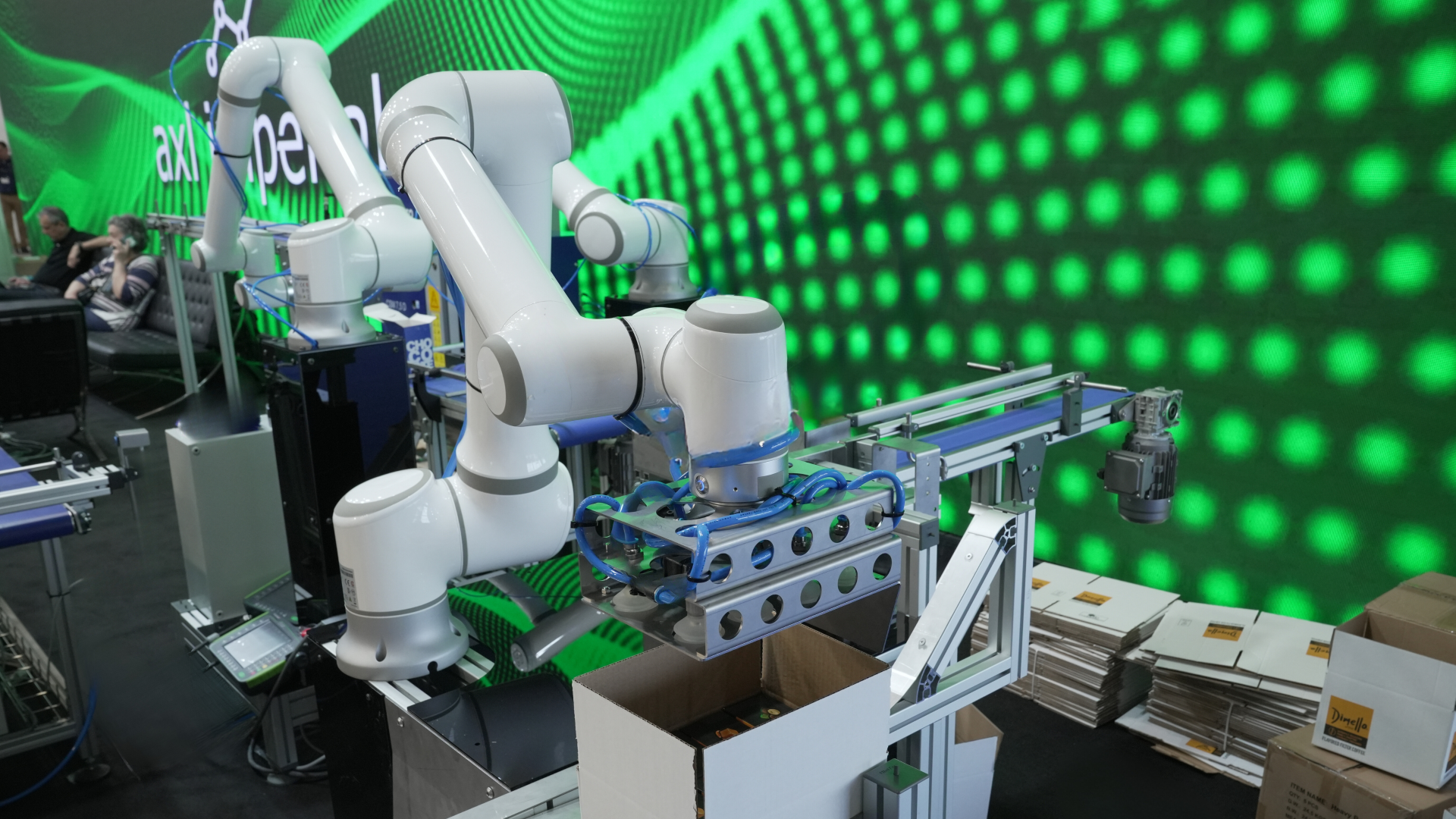
Case Packing
Reimagined
Case Packing Reimagined: How Robotic Cells Are Bringing Speed, Consistency and Flexibility to End-of-Line Packaging
By the time a product reaches the end of the production line in a factory, many things have already gone right in an automated way. Raw materials have been processed, assembled, or formed. Quality checks have been passed. The products are finished, compliant, and ready. And then they arrive at the case packing station, where in a surprising number of plants, some workers are still placing them into a box by hand.
The Case Packing Problem: Why This Station Is Harder to Run Than It Looks
Case packing looks simple from the outside. Pick the product, place it in a box, repeat until the box is full. But sustaining that operation at production line speed across a full 8-hour shift, with the placement accuracy and pack consistency that customers demand, is a different matter entirely. This is the reason why case packing operators face one of the highest turnover rates on the factory floor. This compounds into increase of the injury rates, sick leave patterns, and the steady reluctance of new recruits to stay.
Beyond the staffing challenge, we need to consider the quality variable. A rested operator at the start of a shift packs consistently. The same operator three hours later, on a warm floor, with a line running at full speed, packs differently. Product placement within the case becomes less precise. Fill patterns drift. Box integrity suffers. These are not catastrophic failures, but they are the kind of cumulative inconsistency that generates complaints from distribution partners, creates problems on retail shelves, and quietly erodes the reputation of a nonetheless, well-manufactured product.
For manufacturers who have already invested in automating upstream production, running case packing manually is hard to justify. From both operational and commercial perspectives.
What Robotic Case Packing Actually Involves
Theoretically, robotic case packing is a robot arm putting products into a box. Looking closer however, we will see a coordinated process involving several integrated functions working in sequence.
Products arrive from the production line on an infeed conveyor, oriented and spaced for the pick operation. A vision system verifies the position and orientation of each product before the pick, allowing the robot to adjust its approach in real time rather than relying on perfect upstream consistency. The robotic arm, equipped with end-of-arm tooling matched to the specific product format, picks a single item (or a group of items) and places it into the case according to a programmed pack pattern. This pattern is engineered to maximize case fill, protect product integrity during transit, and meet the presentation requirements of some end customers (i.e. in retail). Once the case is filled, it moves to sealing and labelling before continuing down the line.
Each element of this sequence contributes to the overall result. A robotic case packing system is as reliable as its least reliable component, which is why the integration of all elements into a coherent and well-engineered cell matters as much as the robot function itself.
Why Collaborative Robots Are the Natural Fit for Case Packing
Collaborative robots have emerged as the natural fit for most applications, and the reasons are rooted in the specific characteristics of the task.
Case packing typically involves products in the light to medium weight range, cycle times that are moderate rather than extreme, and production environments where multiple product types, box formats, or pack patterns need to be accommodated across the working week. These are conditions that play directly to the strengths of cobot systems. They can be reprogrammed quickly when a product changeover requires a different pack pattern or a new box format, without specialist robotics programming expertise. Moreover, cobots can operate safely alongside human workers on the packaging line without requiring a full safety enclosure, which simplifies floor layout and reduces the infrastructure investment needed to deploy them. Additionally, their price level makes case packing automation a viable investment for mid-size manufacturers.
This set up, however, has its limitations. Where throughput demands are very high and cycle times leave no margin, a standard cobot installation will not be able to cope. For those applications, a different configuration is required.
The FlexiPacker: When the Line Runs Too Fast for a Static Pick
On high-speed packaging lines, the bottleneck created by a static pick position is a genuine constraint. A robot waiting for a product to arrive at a fixed point, complete the pick, and then wait for the next product introduces a cycle time limitation that the line speed may not be able to accommodate. The flexi packer was developed specifically to address this.
In a flexi packer configuration, the robotic collection head does not wait for the product to come to it. It moves in full synchronization with the conveyor belt, tracking the product in motion and completing the pick without stopping the flow. The effect on cycle time is significant. By eliminating the wait at a static pick point, or a buffer zone, our system can operate at much faster speeds than those of a conventional cobot case packer, while maintaining the required placement accuracy and pack consistency.
The ergonomic dimension is equally important. On high-speed manual packing lines, operators accumulate fatigue and are prone to injuries, as they try to keep up with a fast-moving conveyor belt. The flexi packer removes that exposure entirely, replacing the most physically demanding version of case packing with a system that is safer and runs faster, more consistently, and without fatigue.
The Complete Case Packing Cell: Integration Is Everything
In case packing, the robotic arm is one component within a broader system. Therefore, the performance of the entire cell depends on how well all of its elements have been engineered to work together.
A complete robotic case packing cell includes the product infeed conveyor, the vision system for position verification (or a mechanical calibration mechanism), the robot with its product-specific end-of-arm tooling, the case erection unit that forms flat-packed boxes into open cases ready for filling, the sealing and labelling equipment downstream, reject systems for cases that fall outside specification, safety systems defining the operating zone, and an HMI control panel that gives operators full visibility and control over the entire cell from a single interface.
Pre-integrated case packing cells, where all of these components have been selected, configured, and tested to work together as a system, deliver a fundamentally different installation and commissioning experience from assembling equivalent components from separate suppliers. The system's accountability is clear, the integration risk is reduced, and the time from installation to reliable production output is significantly shorter.
Your End of Production Line Can Be Better
End-of-line packaging has historically received less automation investment than upstream production processes, partly because it appears simpler, and partly because the true cost of running it manually is distributed across staffing, quality, and logistics rather than showing up as a single visible figure.
This calculation, however, is changing. Today, robotic case packing technology is mature, accessible, and well proven across food and beverage, pharmaceutical, personal care, and consumer goods manufacturing. The workforce pressures that have accelerated automation investment upstream are now arriving at the packaging line with the same force. And the solutions available today, from standard cobot case packers to high-speed flexi packer systems, cover a wide range of application requirements that fit most.
Axl Imperial has developed its own complete case packing cell solutions around collaborative robot platforms, engineered for rapid deployment and flexible adaptation across different product formats and pack configurations. Contact us to discuss your case packing requirements or to arrange a live demonstration of a working robotic case packing cell.
Contact Us More Articles