
Axl Imperial is an international manufacturer and supplier of automation, measurement control and testing devices for advanced industrial and laboratory use.
Utilising the design of state-of-the-art equipment and know-how in the field of automation and high-precision industrial measurement and control, Axl Imperial offers production processes and automation solutions to the most demanding needs of modern industry.
Consisting of a variety of engineers, each with great experience in specific industrial segments as automation, motion, measurement and control, the company provides integrated services, from design, development and installation of industrial equipment, to technical consulting, service and after-sales support, for all industrial needs as high precision in-line and laboratory measurements and quality control.
Axl Imperial seeks to constantly improve the quality of the services and systems provided, with the sole criterion, the principle, that quality and economy in production are the key prerequisites for a healthy industrial development and high quality products.
From the
Conveyor
onto the Pallet
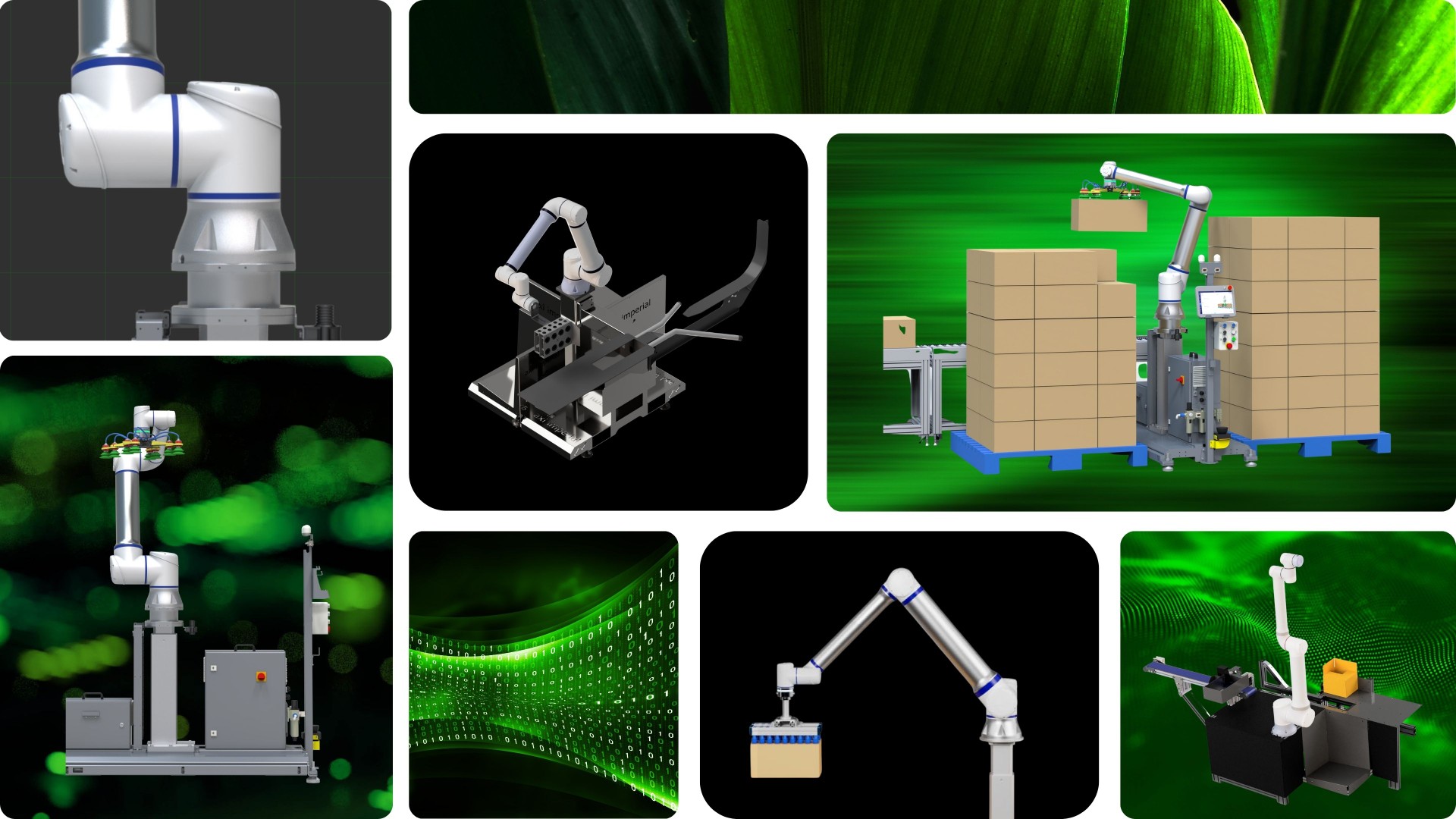
From the Conveyor onto the Pallet: A Complete Look at End-of-Line Factory Automation with Robotic Cells
In the manufacturing world, it is common knowledge. A production line is only as strong as its weakest station. And although most manufacturers apply this principle rigorously upstream, there are facilities that abandon this discipline just before the end of the line. This explains why we see products being manufactured and inspected to a high standard pass through a manually operated case packing station, travel along a poorly buffered conveyor, and arrive at a palletizing cell where output consistency depends on who is on shift.
End-of-line automation is not, and should not be, a separate project from production automation. It is the final chapter of it, and the results of treating it as a complete system rather than a series of individual stations are significantly different.
What End-of-Line Actually Covers
In most production environments, the end-of-line sequence begins where the finished product leaves the primary production or filling process and ends when a warehouse-ready pallet exits the packaging area. Between those two points we usually have:
- Case packing, where individual products are grouped into shipping cases
- Conveyor and transfer systems connecting each station
- Palletizing, where filled cases are stacked onto pallets in defined patterns and
- Stretch wrapping and labelling before dispatch.
Each step has its own equipment, failure modes, and staffing requirements. Together however, they form a process that is more complex and more automatable than it appears from a distance.
Case Packing: The First Robotic Station
The case packing cell is where individual product units become shippable cases. Products arrive on an infeed conveyor, a vision system or mechanical calibration mechanism verifies each product position, and the robotic arm places items into the open case according to a programmed pack pattern optimized for fill, product protection, and customer presentation. The cobot-based configuration handles most light to medium weight applications with the flexibility to accommodate multiple product types or box formats.
For high-speed lines where a static pick position creates a throughput bottleneck, a flexi packer, where the robotic head moves in synchronization with the belt, resolves the constraint without compromising placement accuracy.
Conveyor and Transfer Systems: What Most Project Plans Underestimate
The conveyor and transfer infrastructure connecting robotic cells is the most consistently underspecified element in end-of-line planning, and the one that most often determines whether a multi-cell system performs as designed. Buffering stations decouple the operating rhythm of each cell from those around it, absorbing the speed variations and brief stoppages that occur in any real production environment. Without them, a momentary pause at the palletizing station propagates back through the system and disrupts case packing output.
Accumulation conveyors, buffer zones, transfer units, diverters, and roller tables are not the focal point of most automation investment conversations, but they are the connective tissue that determines whether individual cells function as a coherent line or create bottlenecks for each other.
Robotic Palletizing: The Final Productive Step
Following the production sequence downstream, the palletizing cell receives sealed cases from the conveyor system and builds them into stable pallets. A vision system may help confirm case position and orientation on the infeed, the robot executes the stacking pattern, and the completed pallet moves to stretch wrapping and dispatch labelling.
The choice between a collaborative robot and an industrial robot follows the logic of payload, cycle time, and throughput volume, as we have covered in detail in our previous palletizing article. What matters at system level is that the palletizing cell is specified in alignment with the case packing output rate upstream, so that neither station constrains total line throughput. Pallet dispensers and integrated stretch wrapping complete the sequence, leaving no manual handling required once product exits the primary production process.
Control Architecture: Turning Individual Cells into an Integrated Line
A set of robotic cells connected by conveyors is not, by itself, an automated line. HMI panels can give operators visibility into the status and alarm conditions of each station. However, there must be a supervisory control layer above them to aggregate everything into a single interface for the entire end-of-line sequence. When a fault occurs at one station, the control system communicates the condition to adjacent cells, allowing buffering to absorb the interruption rather than triggering a full line stoppage.
This integration layer is what separates a well-engineered end-of-line system from one requiring constant operator intervention, and what makes the system adaptable as production requirements evolve, without rebuilding the integration from scratch.
End-of-Line as a Functional System
The most common mistake is treating each end-of-line station as a separate project. For example, investing in an automated case packing cell specified without reference to the palletizing cell it feeds, or a control architecture assembled after the fact from individual machine requirements.
On the other hand, manufacturers who approach end-of-line with a whole-system view commission faster, operate more reliably, and adapt more easily over time. The journey from conveyor to pallet is a complete and engineerable process. And the results reflect how completely it has been engineered.
At Axl Imperial we design and install complete end-of-line automation systems, including robotic case packing cells, conveyor and transfer infrastructure, and robotic palletizing cells, for a wide range of manufacturing industries. Contact us to discuss your end-of-line requirements or to arrange a live demonstration.
Contact Us More Articles